Mathematicians Awarded for 2024 Expository Mathematical Writing in MAA
Publications
Paul R. Halmos-Lester R. Ford Award (2024)
Judith B. Bruckner, Brian S. Thomson and Andrew M. Bruckner Can One Visualize a
Continuous Nowhere Differentiable Function? The American Mathematical Monthly,
130:3, 214-221.
Although a continuous nowhere differentiable function (aka a
“monster”) is a classic example in introductory analysis texts, it is not very
easy to visualize. The authors offer a geometric approach that avoids the
computational and visual complications of using infinite sums of functions for
constructing monsters. This lively paper gives readers a chance to reevaluate
their visual concept of a continuous nowhere differentiable function
Friday, October 10, 2025


Saturday, September 24, 2022
Dr Hongjian Shi (trasnlator into Chinese of one of our textbooks)
I haven't been in touch with Dr Shi in quite a while. The last institute I remember was @sustech.edu.cn. he publishes in electrical engineering, so maybe he can be traced down from recent papers.
Sunday, January 31, 2016
Chinese Edition of Elementary Real Analysis (Thomson, Bruckner, Bruckner)

Copies can be obtained from the publisher directly or by contacting either of the two translators (Dr. Shi or Ms. Lee). Contact me for details.
As always the original English language version is available for free download on our website and an inexpensive paperback listed for purchase on Amazon.
Saturday, May 9, 2015
Useful Online Advanced Math Textbooks?
On LinkedIn just recently a mathematics student, Benjamin Bowden, posted this question.
I think a bit of time googling this question might have led somewhere, but perhaps not. One professional mathematician made this suggestion:
Does anybody know of any useful, accessible, and manageable (preferably free) online textbooks for undergraduate math courses? I found this one (http://www.math-cs.gordon.edu/~kcrisman/mat338/index.html) for Number Theory very good when I used it and I'm wondering if anybody knows of any others.
I think a bit of time googling this question might have led somewhere, but perhaps not. One professional mathematician made this suggestion:
Readers of this blog (if any) will know about the following. But I repeat it here in case there is anyone out there asking the same question and stumbling, for the first time on this blog.11 hours ago
I believe that this is the future of textbooks, especially in mathematics. Having published with a major commercial publisher of textbooks who shall remain nameless (Pearson!) who priced our textbooks in the stratosphere, I find now it much more sensible to offer free PDFs and inexpensive paperbacks directly.Students need all the financial assistance they can get nowadays. Free textbooks are an excellent way to help in a small way. We academic mathematicians can make better use of our expository talents than enriching the commercial publishing industry.
All of our textbooks are online at
http://classicalrealanalysis.info/com/Home.php
and PDF copies are free. Mostly these are real analysis textbooks from an elementary level up to graduate.
Also there is a more general source of free mathematical textbooks available
at
http://aimath.org/textbooks/approved-textbooks/
collected and authenticated by the American Institute of Mathematics.
Wednesday, November 13, 2013

Link to Amazon for the Chinese translation of TBB
Here is a link to the Amazon listing for this Chinese language textbook, published today.
Chinese Language Edition of "Elementary Real Analysis"
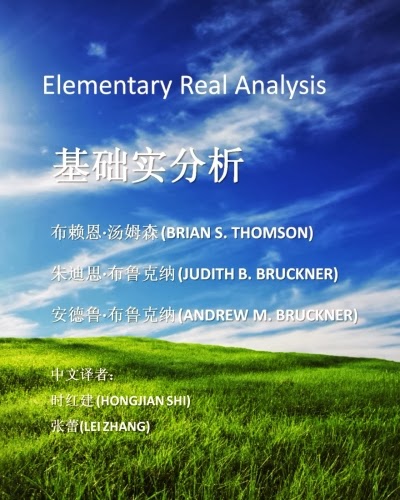
This is a Chinese language translation of the first eight chapters of our elementary real analysis textbook.
It can be purchased directly from CreateSpace or from Amazon.com by following the links below. I will shortly put up some sample pages on our web site ClassicalRealAnalysis.com.
This excellent and accurate translation was done by two accomplished mathematicians: Hongjian Shi and Lei Zhang.
- Publication Date: Nov 13 2013
- ISBN/EAN13: 1492864188 / 9781492864188
- Page Count: 332
- Binding Type: US Trade Paper
- Trim Size: 8" x 10"
- Language: Chinese
- Color: Black and White
- Related Categories:Mathematics / Mathematical Analysis
Purchase information on CreateSpace.
Purchase information on Amazon.
Wednesday, August 7, 2013
What We Are Doing about the High Cost of Textbooks
There is an interesting article in the current issue of the Notices of the American Mathematics Society (August 2013) from the AIM (American Institute of Mathematics) Editorial Board. The first paragraph:
What We Are Doing about the High Cost of Textbooks
Let’s begin with the obvious: The price of textbooks
has risen much faster than the cost of living over
the last thirty years, but there has not been a
significant increase in their quality. We don’t
propose to analyze the economic and educational
factors that underlie this phenomenon. Instead,
we will describe our efforts to help lower the
cost of textbooks for standard undergraduate
mathematics courses in North American colleges
and universities.
Here is a link to the entire article:
http://www.ams.org/notices/201307/rnoti-p927.pdf
In our own smaller way we have done the same thing since 2008 with our mathematics textbooks. All of our texts are available as FREE PDF files as well as inexpensive paperbacks from either Amazon or CreateSpace. I expect that this is the future of publishing for academic mathematicians if not for all disciplines.
Our experience with publishing in the traditional way with a well-known publisher, who should remain nameless (Pearson!), was not at all rewarding. The texts were outrageously expensive for the students, they offered minimal assistance in preparing the manuscript, scarcely any promotion, modest royalties, and (worst of all) they simply dropped the title from their list (without informing us) when they thought they could make more money with another one. Creating our web site classicalrealanalysis.com and distributing our texts there has been much more rewarding.
We have no connection (as yet) with the AIM people who are a part of a
larger NSF project1 to develop open source software and curriculum materials for undergraduate mathematics education. But we agree that this is the future.
1 Information about Project UTMOST (Undergraduate Teach-
ing in Mathematics with Open Software and Texts) can be
found at http://utmost.aimath.org.
Monday, June 17, 2013
Updated files (June 2013) for THEORY OF THE INTEGRAL
I have updated the FREE PDF file for the text
Click here for the PDF.
Click here to visit the web page on the site.
Thanks go to one of our more alert readers (Tom Savage) for spotting that the correction factor in the integration by parts formula for the Stieltjes integral was misstated (i..e, wrong!) in Section 5.7.
This version of the file has this error corrected. I also made a small addition to Section 1.2. Adam Besenyei supplied me with a reference to an early paper of the American mathematician Osgood who addressed the problem discussed in that section.
THEORY OF THE INTEGRAL
Click here for the PDF.
Click here to visit the web page on the site.
Thanks go to one of our more alert readers (Tom Savage) for spotting that the correction factor in the integration by parts formula for the Stieltjes integral was misstated (i..e, wrong!) in Section 5.7.
This version of the file has this error corrected. I also made a small addition to Section 1.2. Adam Besenyei supplied me with a reference to an early paper of the American mathematician Osgood who addressed the problem discussed in that section.
Monday, June 10, 2013
Review of "The Calculus Integral"
Our textbook THE CALCULUS INTEGRAL has just been reviewed in the most recent issue of the American Math Monthly:
Table of Contents June/July 2013 Math Monthly
The review, by David Bressoud, covers
- Calculus by Michael Spivak;
- Calculus Deconstructed: A Second Course in First-Year Calculus by Zbigniew Nitecki;
- Approximately Calculus by Shahriar Sharhriari;
- A Guide to Cauchy's Calculus: A Translation and Analysis of Calcul Infinitesimal by Dennis M. Cates;
- The Calculus Integral by Brian S. Thomson
...``The final book is the most challenging of all, Brian Thomson’s The Calculus Integral. The author introduces it as appropriate for an honors course in calculus, but it would require some very special students. I could see it used for a senior seminar. Every proof, every example, and every counterexample is left as an exercise. The proofs
are scaffolded and answers are provided in the second half of the book, but if approached as intended, working through this text would be daunting. Like Nitecki and Spivak, Thomson focuses on the theorems of calculus. He begins with sequences, the careful derivation of properties of continuous functions, and the definition and basic
properties of differentiation. He takes an abrupt turn when he gets to integration. Like the other four authors, Thomson rejects Riemann’s definition of the definite integral, but he takes it a step further. He returns to Newton’s definition of the integral as antiderivative, what he calls “the calculus integral.” Thomson defines the definite integral
of f as the change in a uniformly continuous function that is an antiderivative of f at all but at most finitely many points. A function is integrable if and only if such an antiderivative exists. The fundamental theorem of integral calculus is now the observation, via the mean value theorem, that for any integrable function f and any partition
of the interval over which we integrate, for each i there exists a value xi in the ith subinterval such that the definite integral is exactly the sum over i of f (xi ) times the length of the ith subinterval. From here, he explores Riemann sums as approximations to definite integrals. Thomson’s handling of integration has the advantage that it clarifies the point of the fundamental theorem of integral calculus, which is the general equivalence of two very different approaches to integration.
There is much more to Thomson’s book. He continues on to the monotone convergence theorem, then to sets of measure zero, to absolute continuity, and on to define the Lebesgue integral of f as the change in a function F that is an antiderivative of f almost everywhere and is absolutely continuous in the Vitali sense. He concludes with
the Henstock–Kurzweil integral. His book is magnificent, but even if we stop before preparing for the monotone convergence theorem, it would be supremely demanding for an honors course in the first year.''
Students and teachers of integration theory should be familiar with David Bressoud whose two "radical" books are must reads for anyone with a serious interest in this subject.
Sunday, February 10, 2013
Theory of the Integral
Now published (February 10, 2013)
 Theory of the Integral by Brian S Thomson
Theory of the Integral by Brian S Thomson
List Price:
$15.88
6" x 9"
(15.24 x 22.86 cm)
Black & White on Cream paper
422 pages
Black & White on Cream paper
422 pages
ISBN-13:
978-1467924399
(CreateSpace-Assigned)
ISBN-10: 1467924393
BISAC: Mathematics / Advanced
ISBN-10: 1467924393
BISAC: Mathematics / Advanced
This text is intended as a treatise for a rigorous course introducing the elements of
integration theory on the real line. All of the important features of the Riemann integral,
integration theory on the real line. All of the important features of the Riemann integral,
the Lebesgue integral, and the Henstock-Kurzweil
integral are covered.
The text can be considered a sequel to the four
chapters of the more elementary
text The Calculus Integral which can be downloaded from our web site.
For advanced readers, however, the text is self-contained.
CreateSpace eStore:
https://www.createspace.com/3721902
This title can be purchased directly from the CreateSpace link above. It is currently active on Amazon.com and should soon be as well as the European and UK Amazon sites.
As always our titles are available for FREE download as PDF files in addition to the offer of inexpensive paperback editions.
Thursday, January 31, 2013
Unprepared for College?
The blogger at College@Home sent me an interesting infographic illustrating just how unprepared the great majority of American high school students are for college level instruction.
While the readers of our blog (focusing on real analysis) are not in this
category, they may likely end up at some time in their career teaching freshman level mathematics. The phenomenon is particularly acute for mathematics instruction: many students arrive with their stellar math grades from high school and end up completely crushed by a simple calculus course. There is a huge gap between the understanding expected at the high school level and the demands and ideas at the level just above.
Much can be written about this (I won't). Here I want to mention that the same thing can happen with an elementary real analysis course. I have never taught this subject without a few "weepers." These are students who have always been convinced that they are "good at mathematics." They aced the calculus courses, and yet are overwhelmed at the elementary real analysis level. They can understand everything in class (they claim) but simply cannot write a correct proof for even the most trivial limit theorems of the course. They have miserably failed the first midterm, something that they couldn't conceive would happen to them ever.
Why is analysis so difficult? They aren't much amused when I tell them that this material was routinely taught in the former Soviet Union to 15 year olds.
Early study of any subject may not prepare you for the next level. Real analysis courses are very subtle (not difficult really) and demand greater insight and thought than the computational courses that precede them.
Learning a new subject does not always create challenges, but you should be aware that at some time in your life you will certainly encounter a new subject that overwhelms you at first. Perhaps the most important skill you can learn is how to dig yourself out of trouble when a subject bites you hard. You will have to do it eventually.
For high school students, if this happens in the first weeks of college---well enjoy the experience and learn the necessary study skills. You will need them again. For math students--don't get too smug. At some point in your life you will have to work very hard to get to the next level.
We will always find ourselves at some point in our life "unprepared" for the next level of study. Consider it a question of character as to whether you can salvage yourself. As the College@Home blogger points out, probably 75% of college students arrive "unprepared." If we can't improve that percentage, at least we can warn them.
While the readers of our blog (focusing on real analysis) are not in this
category, they may likely end up at some time in their career teaching freshman level mathematics. The phenomenon is particularly acute for mathematics instruction: many students arrive with their stellar math grades from high school and end up completely crushed by a simple calculus course. There is a huge gap between the understanding expected at the high school level and the demands and ideas at the level just above.
Much can be written about this (I won't). Here I want to mention that the same thing can happen with an elementary real analysis course. I have never taught this subject without a few "weepers." These are students who have always been convinced that they are "good at mathematics." They aced the calculus courses, and yet are overwhelmed at the elementary real analysis level. They can understand everything in class (they claim) but simply cannot write a correct proof for even the most trivial limit theorems of the course. They have miserably failed the first midterm, something that they couldn't conceive would happen to them ever.
Why is analysis so difficult? They aren't much amused when I tell them that this material was routinely taught in the former Soviet Union to 15 year olds.
Early study of any subject may not prepare you for the next level. Real analysis courses are very subtle (not difficult really) and demand greater insight and thought than the computational courses that precede them.
Learning a new subject does not always create challenges, but you should be aware that at some time in your life you will certainly encounter a new subject that overwhelms you at first. Perhaps the most important skill you can learn is how to dig yourself out of trouble when a subject bites you hard. You will have to do it eventually.
For high school students, if this happens in the first weeks of college---well enjoy the experience and learn the necessary study skills. You will need them again. For math students--don't get too smug. At some point in your life you will have to work very hard to get to the next level.
We will always find ourselves at some point in our life "unprepared" for the next level of study. Consider it a question of character as to whether you can salvage yourself. As the College@Home blogger points out, probably 75% of college students arrive "unprepared." If we can't improve that percentage, at least we can warn them.
Thursday, December 27, 2012
The problem of characterizing derivatives
I noticed that someone had asked a question not too long ago on the MathOverFlow site about characterizing derivatives. The answers were somewhat helpful but none of the usual experts seems to have dived into the discussion, so there was only limited information.
I did add a comment, but maybe I should post some stuff here for those who happen to have some interest in the problem.
The problem naively is to find some necessary and sufficient condition in order that a function f: [a,b] --> R would be the derivative everywhere in [a,b] of some other function. (For example continuity would be sufficient but certainly not necessary, Baire class 1 would be necessary but not sufficient.)
To research the problem you should consult at least the following:
Chapter seven contains an entertaining and accessible account of the problem, including the original formulation of the problem by W. H. Young.
Andy has updated his discussion of this problem in a 1995 survey article written for the Real Analysis Exchange:
I did add a comment, but maybe I should post some stuff here for those who happen to have some interest in the problem.
The problem naively is to find some necessary and sufficient condition in order that a function f: [a,b] --> R would be the derivative everywhere in [a,b] of some other function. (For example continuity would be sufficient but certainly not necessary, Baire class 1 would be necessary but not sufficient.)
To research the problem you should consult at least the following:
Andrew M. Bruckner, Differentiation of real functions. Lecture Notes in Math., vol. 659, Springer-Verlag, Berlin and New York, 1978, x + 246 pp.or the more recent edition:
Differentiation of real functions.
Second edition. CRM Monograph Series 5. American Mathematical Society, Providence, RI, 1994. xii+195 pp. ISBN: 0-8218-6990-6
Chapter seven contains an entertaining and accessible account of the problem, including the original formulation of the problem by W. H. Young.
Andy has updated his discussion of this problem in a 1995 survey article written for the Real Analysis Exchange:
Bruckner, Andrew M. The problem of characterizing derivatives revisited. Real Anal. Exchange 21 (1995/96), no. 1, 112--133.Since then there have been a few varied expressions of conditions that characterize derivatives in perhaps unusual ways:
- On Characterizing Derivatives, D. Preiss and M. Tartaglia Proceedings of the American Mathematical Society, Vol. 123, No. 8 (Aug., 1995), pp. 2417-2420
- Freiling, Chris,
On the problem of characterizing derivatives.
Real Anal. Exchange 23 (1997/98), no. 2, 805–812. - Brian S. Thomson, On Riemann Sums, Real Analysis Exchange
Vol. 37(1), 2011/2012, pp. 1–22
Tuesday, December 18, 2012
Chinese translations of mathematics articles?
We are working on a Chinese translation of our textbook Elementary Real Analysis. Chinese students can already download a free PDF in the English language version from our web site classicalrealanalysis.com, but they will have to wait a bit for our translated version.
Oddly enough I just learned that the Chinese have begun a journal dedicated to translating articles from English to Chinese. This is part of the letter where they inform me that they have translated a Monthly paper of mine. (They received permission from the MAA -- I was not in the loop.)
For the curious (and the bilingual) here is a link to my paper in English:
Thomson, Brian S.
Monotone convergence theorem for the Riemann integral.
Amer. Math. Monthly 117 (2010), no. 6, 547--550.
and here is a link to a scan of the Chinese version that they published (ISSN 1003-3092):
[Chinese Language Version]
I have no idea how accurate and literate the translation is. Perhaps someone will comment?
Oddly enough I just learned that the Chinese have begun a journal dedicated to translating articles from English to Chinese. This is part of the letter where they inform me that they have translated a Monthly paper of mine. (They received permission from the MAA -- I was not in the loop.)
"I am writing this letter on behalf of the editorial office of "Mathematical Advance in Translation", a translated journal which was sponsored by the Academy of Mathematics and Systems Science (Chinese Academy of Sciences). The journal is non-profit targeting at providing a general information about the world mathematics advances. Many of the appearing articles are translated papers that are well selected from "Notices of AMS" and "Bulletin of AMS", "The Amer. Math. Monthly" and "Mathematics Magazine" of the Mathematical Association of American(MAA), “SIAM News" and " SIAM REVIEW", “EMS Newsletter" and et al. From the very first issue, it always states very clear the originations, including author, title, journal, year, volume and pages, to ensure the reader easily referring to the original. The distribution is in a small scale, only around 600-800 subscriptions, all of them at a cost price, but the journal was very welcomed among the mathematicians, especially those in the rural areas and the young school teachers to them such kind of material are not easily accessible."
For the curious (and the bilingual) here is a link to my paper in English:
Thomson, Brian S.
Monotone convergence theorem for the Riemann integral.
Amer. Math. Monthly 117 (2010), no. 6, 547--550.
and here is a link to a scan of the Chinese version that they published (ISSN 1003-3092):
[Chinese Language Version]
I have no idea how accurate and literate the translation is. Perhaps someone will comment?
Friday, November 9, 2012
A New Approach to College Textbooks. Finally.
That's not our slogan, but the slogan of http://www.flatworldknowledge.com/.
They did indeed come up with a useful (if not quite new) approach. Their original idea (exactly like ours) was to offer free electronic versions of their textbooks as well as inexpensive paperback editions.
Our textbooks are just the ones we have written, and all of them are mathematics textbooks. FlatWorldKnowledge hoped to have all college textbooks in all areas available in their model.
It's a great idea for the students. Free PDF files. If you also want a paperback, then buy one for a reasonable price (not the $100 or more the major publishers want). It's also a great idea for authors. The royalty from the big publishing houses is pretty small anyway, so why not bypass them and give the students a break. Many students just use the free version -- some (enough) buy the paperback.
As it turns out, though, perhaps this "new" idea is not so commercially viable, or, if it is viable, it is just not profitable enough for most entrepreneurs.
FlatWorldKnowledge has now announced:
They did indeed come up with a useful (if not quite new) approach. Their original idea (exactly like ours) was to offer free electronic versions of their textbooks as well as inexpensive paperback editions.
Our textbooks are just the ones we have written, and all of them are mathematics textbooks. FlatWorldKnowledge hoped to have all college textbooks in all areas available in their model.
It's a great idea for the students. Free PDF files. If you also want a paperback, then buy one for a reasonable price (not the $100 or more the major publishers want). It's also a great idea for authors. The royalty from the big publishing houses is pretty small anyway, so why not bypass them and give the students a break. Many students just use the free version -- some (enough) buy the paperback.
As it turns out, though, perhaps this "new" idea is not so commercially viable, or, if it is viable, it is just not profitable enough for most entrepreneurs.
FlatWorldKnowledge has now announced:
"Starting January 1, 2013, we will no longer be providing
students with free access to our textbooks. Yes, the free Web format is
going away, but our mission to provide high quality course materials at
affordable prices remains as strong as ever. Students can read a
complete online textbook with our Study Pass product, which includes
note-taking, highlighting and study aids, for only $19.95. Our prices
remain significantly lower than the $100+ that students are used to
paying for other commercial textbooks."
So it seems it is up to individual academics (like us) to get quality study material directly to students for free and accept the fairly modest compensation for paperback versions that on-demand publishers like CreateSpace offer.
Any thoughts on this?
Saturday, May 19, 2012
Amazon Customers in Europe
press release
May 17, 2012, 9:00 a.m. EDT
CreateSpace Now Offers Independent Authors and Publishers Zero-Cost, Inventory-Free Distribution to Amazon Customers in Europe
Starting today, independent authors and publishers using CreateSpace can distribute their books directly to Amazon.co.uk, Amazon.de, Amazon.fr, Amazon.es and Amazon.it and earn industry-leading royalties...
Our textbooks are now available through Amazon in the UK, Germany, France, Italy, and Spain. If you search on your country's Amazon under books using "real analysis" or "Bruckner and Thomson" you should be able to find us (soon?). If you happen to purchase one of our textbooks this way please send us a note. Sorry, but english language versions only are available at the moment.
As always, of course, free PDF files for all of our books are available at the classicalrealanalysis.com web site.
Wednesday, May 9, 2012
Chinese Edition of Elementary Real Analysis

Sunday, May 6, 2012
We have now made the transition for our web site from M/S Office Live to another server. You can access either of our sites:
classicalrealanalysis.info
or
classicalrealanalysis.com
for information about our real analysis texts, for free PDF downloads, for purchase of paperback editions, or for supplementary material [a work-in-progress] that will assist in your study or teaching of real analysis.
If you have any comments or advice on making these sites more useful please add your thoughts on this blog.
classicalrealanalysis.info
or
classicalrealanalysis.com
for information about our real analysis texts, for free PDF downloads, for purchase of paperback editions, or for supplementary material [a work-in-progress] that will assist in your study or teaching of real analysis.
If you have any comments or advice on making these sites more useful please add your thoughts on this blog.
Friday, February 10, 2012
New ClassicalRealAnalysis.info web site
IMPORTANT NOTICE FEB 10, 2012 | ||
Our .COM web site is being redesigned and moving to a new server.
Go to for all resources now.
The .com site will reopen as a commercial site for the sale of paperback copies of our texts.
|
| |
FREE PDF POLICY: Our new policy is to distribute completely FREE PDF files for all of our texts.
You can find the files on ClassicalRealAnalysis.info
| ||
|---|---|---|
Tuesday, November 29, 2011
FREE PDF FILES (Mathematics)
The YOUPUBLISH web site that we previously used to distribute our files appears to have dropped into a black hole. If you need any of our files please write to me thomson@sfu.ca and I will send you a link to access the files without charge. [November 2011]
The texts currently available are:
- ELEMENTARY REAL ANALYSIS (undergraduate)
- REAL ANALYSIS (graduate)
- MATHEMATICAL DISCOVERY (freshman or senior high school)
- THE CALCULUS INTEGRAL (post calculus [experimental])
- THEORY OF THE INTEGRAL (specialist)
Subscribe to:
Posts (Atom)
http://diestel-graph-theory.com/