I haven't been in touch with Dr Shi in quite a while. The last institute I remember was @sustech.edu.cn. he publishes in electrical engineering, so maybe he can be traced down from recent papers.
Saturday, September 24, 2022
Dr Hongjian Shi (trasnlator into Chinese of one of our textbooks)


Sunday, January 31, 2016
Chinese Edition of Elementary Real Analysis (Thomson, Bruckner, Bruckner)

Copies can be obtained from the publisher directly or by contacting either of the two translators (Dr. Shi or Ms. Lee). Contact me for details.
As always the original English language version is available for free download on our website and an inexpensive paperback listed for purchase on Amazon.
Saturday, May 9, 2015
Useful Online Advanced Math Textbooks?
On LinkedIn just recently a mathematics student, Benjamin Bowden, posted this question.
I think a bit of time googling this question might have led somewhere, but perhaps not. One professional mathematician made this suggestion:
Does anybody know of any useful, accessible, and manageable (preferably free) online textbooks for undergraduate math courses? I found this one (http://www.math-cs.gordon.edu/~kcrisman/mat338/index.html) for Number Theory very good when I used it and I'm wondering if anybody knows of any others.
I think a bit of time googling this question might have led somewhere, but perhaps not. One professional mathematician made this suggestion:
Readers of this blog (if any) will know about the following. But I repeat it here in case there is anyone out there asking the same question and stumbling, for the first time on this blog.11 hours ago
I believe that this is the future of textbooks, especially in mathematics. Having published with a major commercial publisher of textbooks who shall remain nameless (Pearson!) who priced our textbooks in the stratosphere, I find now it much more sensible to offer free PDFs and inexpensive paperbacks directly.Students need all the financial assistance they can get nowadays. Free textbooks are an excellent way to help in a small way. We academic mathematicians can make better use of our expository talents than enriching the commercial publishing industry.
All of our textbooks are online at
http://classicalrealanalysis.info/com/Home.php
and PDF copies are free. Mostly these are real analysis textbooks from an elementary level up to graduate.
Also there is a more general source of free mathematical textbooks available
at
http://aimath.org/textbooks/approved-textbooks/
collected and authenticated by the American Institute of Mathematics.
Wednesday, November 13, 2013

Link to Amazon for the Chinese translation of TBB
Here is a link to the Amazon listing for this Chinese language textbook, published today.
Chinese Language Edition of "Elementary Real Analysis"
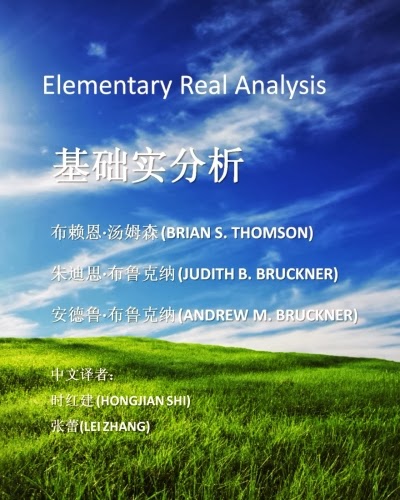
This is a Chinese language translation of the first eight chapters of our elementary real analysis textbook.
It can be purchased directly from CreateSpace or from Amazon.com by following the links below. I will shortly put up some sample pages on our web site ClassicalRealAnalysis.com.
This excellent and accurate translation was done by two accomplished mathematicians: Hongjian Shi and Lei Zhang.
- Publication Date: Nov 13 2013
- ISBN/EAN13: 1492864188 / 9781492864188
- Page Count: 332
- Binding Type: US Trade Paper
- Trim Size: 8" x 10"
- Language: Chinese
- Color: Black and White
- Related Categories:Mathematics / Mathematical Analysis
Purchase information on CreateSpace.
Purchase information on Amazon.
Wednesday, August 7, 2013
What We Are Doing about the High Cost of Textbooks
There is an interesting article in the current issue of the Notices of the American Mathematics Society (August 2013) from the AIM (American Institute of Mathematics) Editorial Board. The first paragraph:
What We Are Doing about the High Cost of Textbooks
Let’s begin with the obvious: The price of textbooks
has risen much faster than the cost of living over
the last thirty years, but there has not been a
significant increase in their quality. We don’t
propose to analyze the economic and educational
factors that underlie this phenomenon. Instead,
we will describe our efforts to help lower the
cost of textbooks for standard undergraduate
mathematics courses in North American colleges
and universities.
Here is a link to the entire article:
http://www.ams.org/notices/201307/rnoti-p927.pdf
In our own smaller way we have done the same thing since 2008 with our mathematics textbooks. All of our texts are available as FREE PDF files as well as inexpensive paperbacks from either Amazon or CreateSpace. I expect that this is the future of publishing for academic mathematicians if not for all disciplines.
Our experience with publishing in the traditional way with a well-known publisher, who should remain nameless (Pearson!), was not at all rewarding. The texts were outrageously expensive for the students, they offered minimal assistance in preparing the manuscript, scarcely any promotion, modest royalties, and (worst of all) they simply dropped the title from their list (without informing us) when they thought they could make more money with another one. Creating our web site classicalrealanalysis.com and distributing our texts there has been much more rewarding.
We have no connection (as yet) with the AIM people who are a part of a
larger NSF project1 to develop open source software and curriculum materials for undergraduate mathematics education. But we agree that this is the future.
1 Information about Project UTMOST (Undergraduate Teach-
ing in Mathematics with Open Software and Texts) can be
found at http://utmost.aimath.org.
Subscribe to:
Posts (Atom)
http://diestel-graph-theory.com/